Influence de la température de cuisson sur les propriétés thermo-hydro-mécaniques d’une brique en terre cuite
- Post by: SOAPHYS-KZ
- 15 décembre 2025
- Comments off

http://dx.doi.org/10.46411/jpsoaphys.2025.C25.10
Section de la parution: Informations de publication
J. P. Soaphys, Vol 5, N°2 (2025) C25A10
Pages : C23A10-1 à C25A10-7
Informations sur les auteurs et affiliations
Tiendrebeogo Eloi Salmwendé1,2*, Guy Christian Tubreoumya2, Zerbo Désiré2, Zakaria Guene2, Alfa Oumar Dissa2
1Ecole Normale Supérieure (ENS), BP :1757, Koudougou 01, Burkina Faso ;
2Laboratoire de Physique et de Chimie de l’Environnement (LPCE), Université Joseph KI-ZERBO, BP 7021 Ouagadougou 03, Burkina Faso.
Corresponding author e-mail : tiendrebeogoeloi@yahoo.fr
ABSTRACT
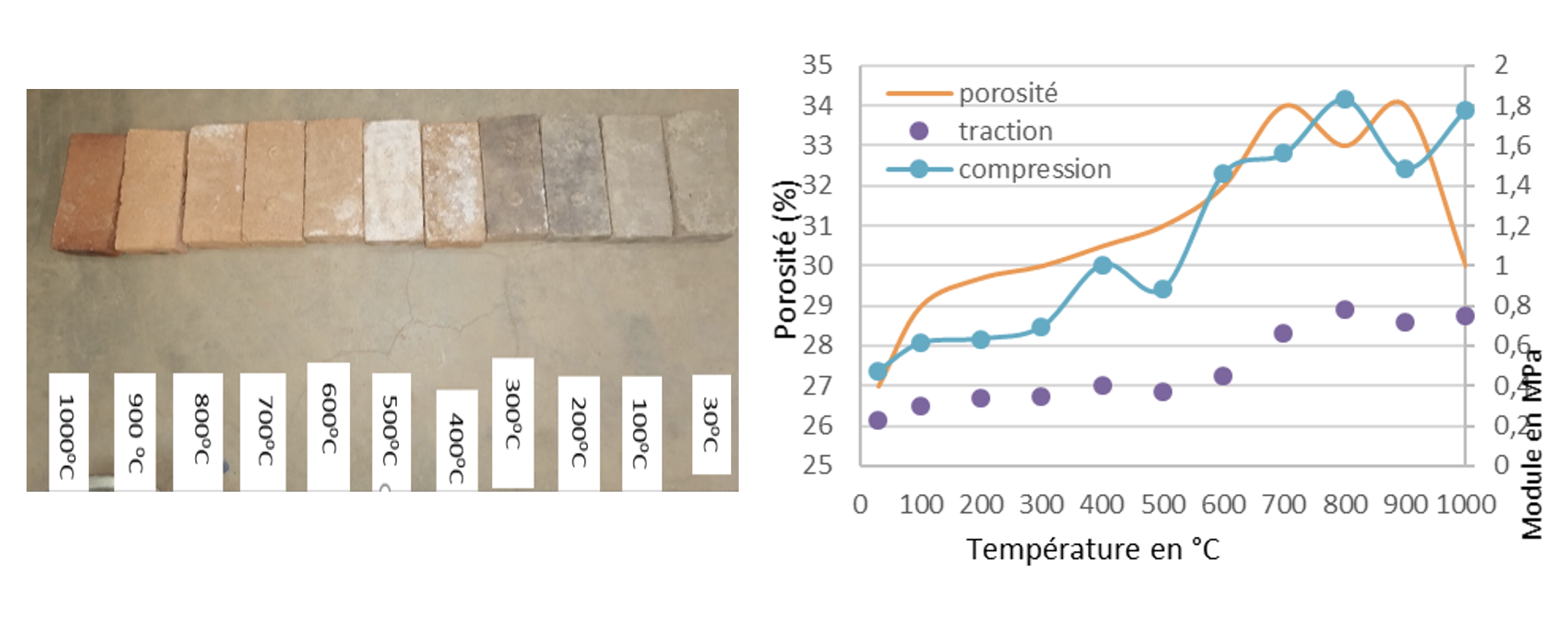
This work focuses on the characterization of a clay-based terracotta brick extracted in Kounda, south-central region, Burkina Faso. The aim was to evaluate the influence of the firing temperature of a terracotta brick on the geotechnical and physical properties. Characterization according to current standards of parameters such as : particle size ; the natural water content of around 6.6 % ; porosity; Atterberg limits were carried out for the classification of the material studied. It appears from these tests that during the cooking period, the material becomes more porous by 27 to 34%, fragile at times. The liquidity limit and the plasticity limit are respectively of the order of 40% and 20%, giving a plasticity index of 20%. The latter made it possible to classify the present material among moderately plastic inorganic clays and at the limit of swelling according to the Cassagrande diagram. The compression and simple tensile test results obtained during this experimental phase vary respectively from 4 to 18.8 MPa and from 0.23 to 0.78 MPa for the different samples depending on the cooking temperature. The maximum values of the parameter characteristics are obtained at a temperature of around 800℃. At this temperature, the material becomes less porous and solid. This type of material can be used for the construction of high temperature ovens or dryers.
RESUME
Ce travail présente la caractérisation d’une brique de terre cuite à base argileuse extraite à Kounda, région du centre sud, Burkina Faso. Il s’agissait d’évaluer l’influence de la température de cuisson sur le comportement géotechnique et physique de l’échantillon du matériau considéré. La caractérisation selon les normes en vigueur des paramètres tels que : la granulométrie ; la teneur en eau naturelle de l’ordre de 6,6 % ; la porosité ; les limites d’Atterberg a été effectuée pour la classification du matériau étudié. Il ressort de ces essais que pendant la période de la cuisson, le matériau devient davantage poreux de 27 à 34 %, fragile par moment. La limite de liquidité et la limite de plasticité sont respectivement de l’ordre de 40% et de 20 % donnant un indice de plasticité de 20 %. Ces dernières ont permis de classer le présent matériau parmi des argiles inorganiques moyennement plastiques et à la limite du gonflement selon le diagramme de Cassagrande. Les résultats d’essai à la compression et à la traction simple obtenus pendant cette phase expérimentale varient respectivement de 4 à 18,8 MPa et de 0,23 à 0,78 MPa pour les différents échantillons en fonction de la température de cuisson. Les valeurs maximales des caractéristiques des paramètres sont obtenues à une température de l’ordre de 800 ℃. A cette température, le matériau devient moins poreux et solide. Ce type de matériau peut être utilisé pour la construction des fours ou des séchoirs à haute température.
Mots-Clés : Caractérisation ; Brique de terre Cuite ; Température ; Propriétés
REFERENCES
Soumia Rahmani, Dalel Kaoula,
Mohamed Hamdy, 2022. Proceedings,
Exploring the thermal behaviour of building materials : Terracotta, concrete
hollow block and hollow brick, under the arid climate, case study of
Biskra-Algeria, Materials Today : Vol. 58, Part 4, pp. 1380-1388
Ushaa S., Deepa G. Nair, Subha
Vishnudas, 2016. Procedia Technology,
Feasibility Study of Geopolymer Binder from Terracotta Roof Tile Waste, 25, pp.
186 – 193
Zoma, F.,
Toguyeni, D. Y., & HASSEL, I. B., 2020. Academic
Journal of Civil Engineering, Formulation et potentialités thermiques d’un
éco-matériau pour le génie civil., 35 (1), pp. 311-314
https://doi.org/10.26168/ajce.35.1.76
COMPAORE, A.,
OUEDRAOGO, B., GUENGANE, H., MALBILA, E., BATHIEBO, D.J, 2017. IRA International Journal of Applied Sciences, Role of Local Building
Materials on the Energy Behaviour of Habitats in Ouagadougou. (ISSN
2455-4499), 8(2), 63-72. doi:http://dx.doi.org/10.21013/jas.v8.n2.p3
Florie Dejeant,
Philippe Garnier, Thierry Joffroy (Dir.), 2021. Matériaux locaux, matériaux
d’avenir : Ressources locales pour des villes et territoires durables en
Afrique. CRAterre,
pp.96, 2021, 979-10-96446-32-2. hal-03293589
S. E. Tiendrebeogo, A. O Dissa, F.
Cherblanc, I. Youm, J. C. Bénet, A. Compaoré, J. Koulidiati, 2015
“Characterization of Two Different Stumps of Spirulina platensis Drying:
Assessment of Water Transport Coefficient,” Food and Nutrition Sciences, Vol 6,
pp. 1437-1449.
http://dx.doi.org/10.4236/fns.2015.615148
Chantal Proust,
Agnès Jullien, Lydie Le Forestier, 2004. C.
R. Geoscience, Détermination indirecte des limites d’Atterberg par
gravimétrie dynamique, 336 1233–123.
https://doi.org/10.1016/j.crte.2004.06.003
Dieudonné
ABESSOLO, Achille Bernard BIWOLE, Didier FOKWA, Bernard Morino GANOU KOUNGANG et
Bernard NYOUMA YEBGA, 2020. Afrique
Science, Effets de la longueur et de la teneur des fibres de bambou sur les
propriétés physicomécaniques et hygroscopiques des Blocs de Terre Comprimée
(BTC) utilisés dans la construction 16(4) 13 – 22
Pierre-Marie Nigay,
2015. physics.class-ph. Etude des
transformations microstructurales de mélanges argile/biomasse lors de la
cuisson et relations avec les propriétés mécaniques et thermiques. Mécanique des
matériaux. Ecole des Mines d’Albi-Carmaux, Français. NNT : 2015EMAC0001
tel-01464117