


Transformation de déchets plastiques de polypropylène en carburant pour usage domestique
- Post by: SOAPHYS-KZ
- 27 décembre 2025
- Comments off

Section de la parution: Informations de publication
J. P. Soaphys, Vol 5, N°2 (2025) C25A12
Pages : C23A12-1 à C25A12-6
Informations sur les auteurs. et affiliations
Seydou DIAWARA, Issiaka TRAORE, Souleymane SANOGO
Laboratoire d’optique de spectroscopie et des sciences atmosphériques (LOSSA), Faculté des Sciences et Techniques, Université des Sciences des Techniques et des Technologies de Bamako
Corresponding author e-mail :* traoreamenophis@gmail.com
ABSTRACT
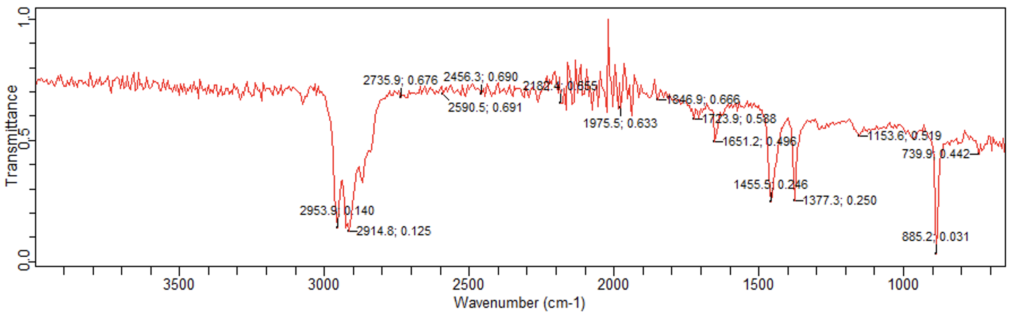
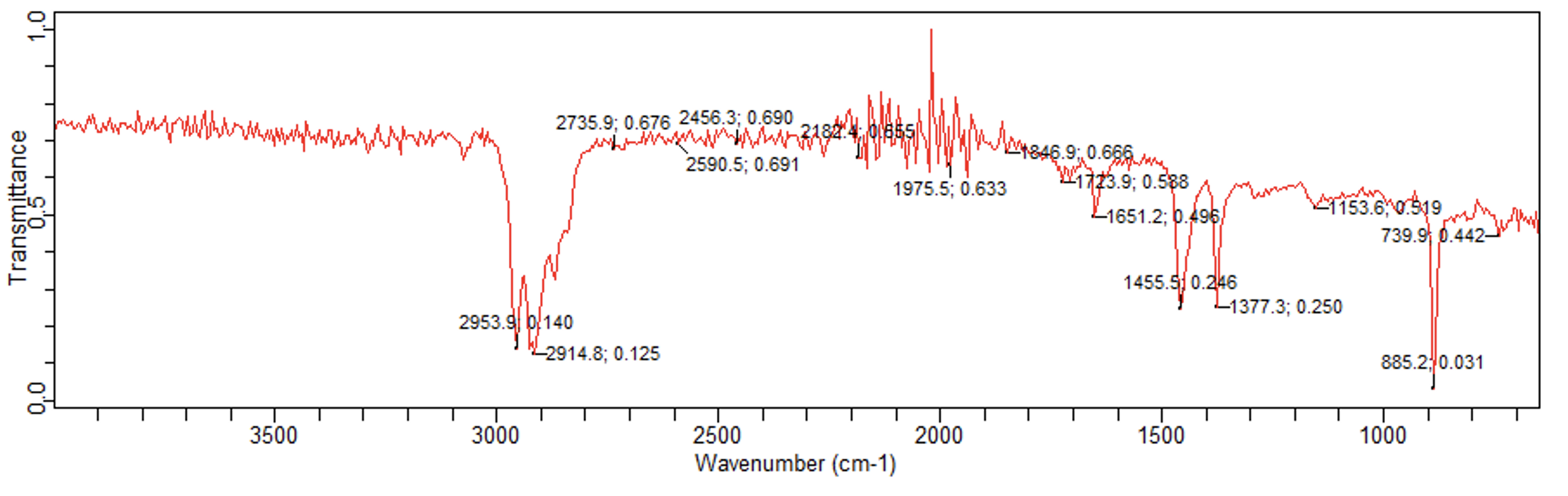
The proliferation of non-biodegradable plastic waste in the environment is a growing threat to our planet, causing disastrous consequences for ecosystems and human health. Faced with this major environmental challenge, this study focuses on the transformation of plastic waste into fuel through non-catalytic thermal pyrolysis. To do this, an experimental device was designed with local materials and at a lower cost. Thanks to this device, a liquid with a density of 787.59 kg/m3 was collected and the mass, conversion and energy yields of the process were estimated at 83%, 81% and 49.3% respectively. Analysis of this liquid by Fourier transform infrared spectroscopy (FTIR) revealed spectral signatures comparable to those of fuels such as gasoline, diesel and kerosene. The technical and economic assessment showed that after two years of operation, a return on investment is possible. The results of the study allowed us to understand that this waste recycling process represents a source of energy that could be economically profitable on a small scale, thus constituting a potential source of income.
Keywords : Plastic waste, polypropylene, Pyrolysis, Fuel, Gasoline
REFERENCES
A. Merrington., 2017. Recycling of Plastics, Appl. Plast. Eng. Handb. 167–189.
doi:10.1016/B978-0-323-39040-8.00009-2.
Chantal Kassargy., 2018. Contribution à l’étude de la
valorisation énergétique des résidus de plastique par craquage catalytique. Génie des procédés. Ecole nationale supérieure Mines-Télécom
Atlantique; École Doctorale des Sciences et de Technologie (Beyrouth). NNT:2018IMTA0077. tel-01883636
Dittenber, D.B., 2012. GangaRao, H.V.S. Critical review of recent publications on
use of natural composites in infrastructure. Compos.
Part A Appl. Sci. Manuf., 43, 1419–1429.
F. Sadaka.,
2010. Etude de la dégradation contrôlée
de polydiènes : application au recyclage des déchets pneumatiques,
Université Du Maine. http://www.theses.fr/2010LEMA1029
FakhrHoseini, S.M., Dastanian, M., 2013. Pyrolysis of LDPE, PP and PET Plastic Wastes
at Different Conditions and Prediction of Products Using NRTL Activity
Coefficient Model.
Arab. J. Chem.
Gao F.,2010. Pyrolysis of waste plastics into fuels. PhD thesis. New Zealand: University
of Canterbury.
Hoornweg, Daniel; Bhada-Tata, Perinaz., 2012. What a Waste : A Global Review of Solid
Waste Management. Urban development series;knowledge papers no. 15. © World
Bank, Washington, DC. http://hdl.handle.net/10986/17388 License: CC BY 3.0 IGO.
J. Walendziewski., 2005. Fuel Processing Technology 86 1265–1278
Jalaluddin, M., 2017. Use of Plastic Waste in Civil Constructions and Innovative Decorative
Material (Eco-Friendly). MedCrave Online J. Civ. Eng. 3, 00082.
Mohamadou Adamou, Mohamed S Maiga, Oumar Cissé,
Joseph Amadomon Sagara et Yaya Ouattara., 2023. Étude expérimentale de la caractérisation des ordures ménagères
de Bamako au Mali. International Journal of Environment,
Agriculture and Biotechnology, 8(2)-2023.
Mohammad Saleem Khan, Inamullah, Mohammad
Sohail, Noor Saeed Khattak., 2016. Conversion of Mixed Low-Density Polyethylene
Wastes into Liquid Fuel by Novel CaO/SiO2 Catalyst. J Polym Environ.
Springer Science+Business Media New York. DOI 10.1007/s10924-016-0768-5
Mohanraj Chandran, Senthilkumar Tamilkolundu,
Chandrasekar Murugesan., 2020. Plastic
Waste and Recycling. ISBN 978-0-12-817880-5© Elsevier Inc.
https://doi.org/10.1016/B978-0-12-817880-5.00014-1.
Ncube, L.K.; Ude, A.U.; Ogunmuyiwa, E.N.;
Zulkifli, R.; Beas, I.N., 2021. An
Overview of Plastic Waste Generation and Management in Food Packaging
Industries. Recycling, 6, 6010012.
Plastics Europe, Plastics – the facts
2014/2015.,2015. An analysis of European
plastics production, demand and
waste data, PlasticsEurope. 1–34.
doi:10.1016/j.marpolbul.2013.01.015.
Plastics-The Facts 2021-Report Plastics.,
Europe. The Association of Plastics Manufacturers
in Europe. Available online: https://plasticseurope.org/pl/knowledge-hub/plastics-the-facts-2021/
(accessed on 13 January 2022).
S.D. Anuar Sharuddin, F. Abnisa, W.M.A. Wan
Daud, M.K. Aroua., 2016. A review on
pyrolysis Of plastic wastes, Energy Convers. Manag. 115, 308–326.
doi:10.1016/j.enconman.2016.02.037.
Sakata, Y., Uddin, M.A., Muto, A., 1999. Degradation of polyethylene and
polypropylene into fuel oil by using solid acid and non-acid catalysts. J.
Anal. Appl. Pyrolysis 51, 135–15.
Shushay Hagos Gebre, Marshet Getaye Sendeku,
Mohamed Bahri. 2021. Recent Trends in the
Pyrolysis of Non-Degradable Waste Plastics. ChemistryOpen, 10, 1202–1226.
Viswanath V., 2010. Degradation Studies of
Polypropylene Fibers and Nonwovens with Prodegradant Additives, M.Sc. Thesis, Graduate Faculty of
North Carolina State University.
article elements
http://dx.doi.org/10.46411/jpsoaphys.2025.C25.12