


Synthèse d’une loi de commande par mode glissant pour l’amélioration des performances de machines asynchrones sous contrainte thermique
- Post by: SOAPHYS-KZ
- 27 décembre 2025
- Comments off

http://dx.doi.org/10.46411/jpsoaphys.2021.C25.15
Section de la parution: Informations de publication
J. P. Soaphys, Vol 5, N°2 (2025) C25A15
Pages : C23A15-1 à C25A15-10
Informations sur les auteurs. et affiliations
Aboubacar Daouda TRAORE1, Fadaba DANIOKO1, 2, Mamadou DANSOKO1, Mamadou BATHILY1
1Centre de Calcul de Modélisation et de Simulation, Faculté des Sciences et Techniques de Bamako, Université des Sciences des Techniques et des Technologies de Bamako (USTT-B), Bamako, Mali
2Equipe MGSI, Laboratoire Quartz EA n° 7393, IUT de Montreuil, Université de Paris 8, 140, rue de la Nouvelle France, 93100 Montreuil, France
Corresponding author e-mail :*traoreaaacar@gmail.com
RESUME
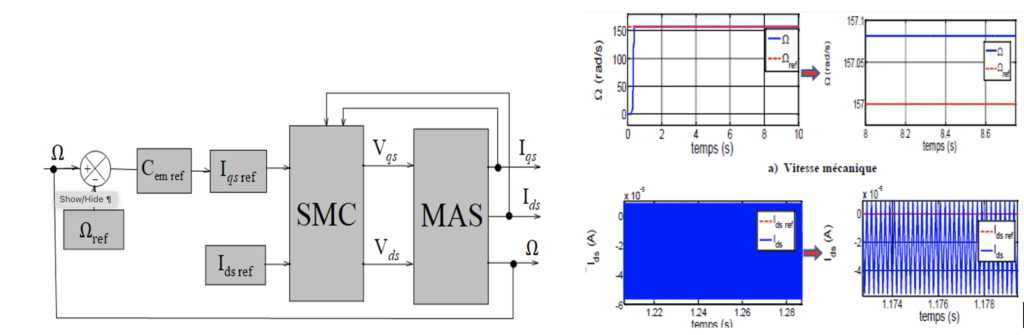
Dans cet article, nous proposons une loi de commande par mode glissant pour l’entrainement des machines asynchrones fonctionnant sous contrainte thermique. Cette loi de commande a pour objectif le contrôle robuste des courants statoriques et de la vitesse mécanique afin d’améliorer dans les usines le comportement dynamique des machines asynchrones soumises aux variations paramétriques et aux perturbations. Le contrôleur proposé est conçu à partir des équations électriques et magnétiques de la machine asynchrone en utilisant le référentiel (dq) lié au stator et en faisant un contrôle de la vitesse mécanique via le couple électromagnétique. Dans un premier temps, nous avons modélisé et simulé avec et sans contrainte thermique la machine asynchrone à vide et en charge sans application de la commande. Dans un second temps, nous avons simulé la machine asynchrone dans les mêmes conditions que précédemment mais en appliquant la commande robuste à mode glissant. Les résultats de simulation obtenus sous Matlab/Simulink ont montré que le système commandé présente des critères de précision acceptable, de poursuite des grandeurs de références satisfaisante et une grande robustesse contrairement au système non commandé où les caractéristiques électromécaniques de la machine sont affectées sous contrainte thermique.
Mots-Clés : mode glissant, commande robuste, amélioration des performances, machine asynchrone, contrainte thermique
ABSTRACT
In this paper, we propose a sliding mode control law for driving asynchronous machines operating under thermal stress. The aim of this control law is to provide robust control of stator currents and mechanical speed in order to improve the dynamic behavior of asynchronous machines subject to parametric variations and disturbances in factories. The proposed controller is designed on the basis of the electrical and magnetic equations of the asynchronous machine, using the reference frame (dq) linked to the stator and controlling the mechanical speed via the electromagnetic torque. Firstly, we modelled and simulated the asynchronous machine at no load and under load without applying the control, with and without thermal stress. Secondly, we simulated the asynchronous machine under the same conditions as before, but using robust sliding mode control. The simulation results obtained using Matlab/Simulink showed that the controlled system has acceptable accuracy criteria, satisfactory tracking of reference values and a high degree of robustness, unlike the uncontrolled system where the electromechanical characteristics of the machine are affected under thermal stress.
Keywords : sliding mode, robust control, improving performance, asynchronous machine, thermal stress
REFERENCES
Acikgoz H., 2021. Real-time adaptive speed control of vector-controlled induction motor drive based on online-trained Type-2 Fuzzy Neural Network Controller. International Transactions on Electrical Energy Systems.
Boubakri L. M., 2021. Contribution à la commande des machines asynchrones à haut rendement (HEM). Thèse de doctorat, République Algérienne, Université Mohamed Boudiaf-M’Sila.
Chagra H., Drihem R., Hamidi Y., Douib S. A., 2022. Commande vectorielle de la machine à induction avec observateur de flux. Mémoire de Master Académique, Université Echahid Hamma Lakhdar d’El-Oued. Spécialité : Electromécanique.
Cheng X., Liu H., Lu W., 2021. Chattering-suppressed sliding mode control for flexible-joint robot manipulators. Actuators Multidiscip. Digit. Publ. Inst. 2021, 10, 288. [CrossRef]
Du C., Yang C., Li F., Gui W., 2019. A Novel Asynchronous Control for Artificial Delayed Markovian Jump Systems via Output Feedback Sliding Mode Approach. IEEE Trans. Syst. Man Cybern. Syst. [CrossRef]
El Kharki A., Boulghasoul Z., Et-Taaj, L. K., Oussi Z., Elbacha A, 2019. Adaptive Speed Control of Induction Motor Drive With Inaccurate Model. In Proceedings of the 2019 4th World Conference on Complex Systems (WCCS), Ouarzazate, Morocco. pp. 1–8.
Gastli A. et Matsui N., 1992. Stator flux controlled V/f PWM inverter with identification of IM parameters (induction motors). IEEE Transactions on Industrial Electronics, Vol. 39, N°4, pp. 334–340.
Gilles G. G., 2014. Modélisation et caractérisation thermique de machines électriques synchrones à aimants permanents. Thèse doctorat, Institut National des Sciences Appliquées de Lyon. pp. 9-39.
Glises R., Hostache G. et Kauffman J. M., 1994. Simulation du comportement thermique en régime permanent d’un moteur asynchrone à refroidissement extérieur : étude par éléments finis. J. Phys. III .France. pp. 1723-1735.
Happyanto D. C., Fauzi R., Hair J, 2016. Backstepping development as controller in fast response three phase induction motor based on indirect field oriented control. In Proceedings of the 2016 International Electronics Symposium (IES), Denpasar, Indonesia. Volume 65, pp. 25–30.
Kataoka T., Sato Y., Bendibdellah A., 1993. A novel Volts/Hertz control method for an induction motor to improve the torque characteristics in the low range. The European Power Electronics association. pp. 485-488.
Lee K., Ahmed S. et Lukic S. M., 2017. Universal Restart Strategy for Scalar (V/f) Controlled Induction Machines. IEEE Transactions on Industry Applications, Vol. 53, N°6, pp. 5489–5495.
Li L., Wang M., Yang R., Fu Y., Zhu D., 2021. Adaptive Damping Variable Sliding Mode Control for an Electrohydrostatic Actuator. Actuators Multidiscip. Digit. Publ. Inst. 2021, 10, 83. [CrossRef]
Lu Y., Tan C., Ge W., Li B., Lu J., 2021. Improved Sliding Mode-Active Disturbance Rejection Control of Electromagnetic Linear Actuator for Direct-Drive System. Actuators Multidiscip. Digit. Publ. Inst. 2021, 10, 138. [CrossRef]
Nguyen P., Quang J. D., 2008. Vector Control of Three-Phase AC Machines. Springer: Heidelberg, Germany.
Pugachev A. A., Drakin A. Y., et Shkolin A. N., 2019. Behavioral simulation of induction motor Temperature distribution. International Transaction Journal of Engineering, Management, & Applied Sciences & Technologies, PAPER ID: 11A03F.
Sahraoui M., 2013. Commandes non linéaires de la machine asynchrone. Mémoire de master en génie électrique, République Algérienne, Université de M’Sila. pp. 3-14.
Shiravani F., Alkorta P., Cortajarena J. A. et Barambones O., 2022. An Enhanced Sliding Mode Speed Control for Induction Motor Drives . MPDI.
Slotine J. J. et Li W., 1991. Applied nonlinear control. Prentice-Hall, USA.
Wang M., Wang Y., Yang R., Fu Y., Zhu D, 2021. A Sliding Mode Control Strategy for an ElectroHydrostatic Actuator with Damping Variable Sliding Surface. Actuators Multidiscip. Digit. Publ. Inst. 2021, 10, 3. [CrossRef]
Yamina Z., 2010. Commande par mode glissant des courants statoriques de la machine asynchrone. Mémoire de Magister, République Algérienne, Université Ferhat Abbas de Setif. pp. 12.
