


ANALYSE D’ADÉQUATION DU SITE POUR L’INSTALLATION PHOTOVOLTAÏQUE DANS LES ZONES RURALES DU MALI
- Post by: SOAPHYS-KZ
- 15 décembre 2025
- Comments off

Section de la parution: Informations de publication
J. P. Soaphys, Vol 5, N°1 (2025) C25A06
Pages : C25A08-1 à C25A08-6
Informations sur les auteurs. et affiliations
Issa Bagayogo, Souleymane Sanogo, Issiaka TRAORE
Laboratoire d’optique de spectroscopie et des sciences atmosphériques (LOSSA), Faculté des Sciences et Techniques, Université des Sciences des Techniques et des Technologies de Bamako.Corresponding author e-mail :* zoungrana.w@edu.wascal.org
ABSTRACT
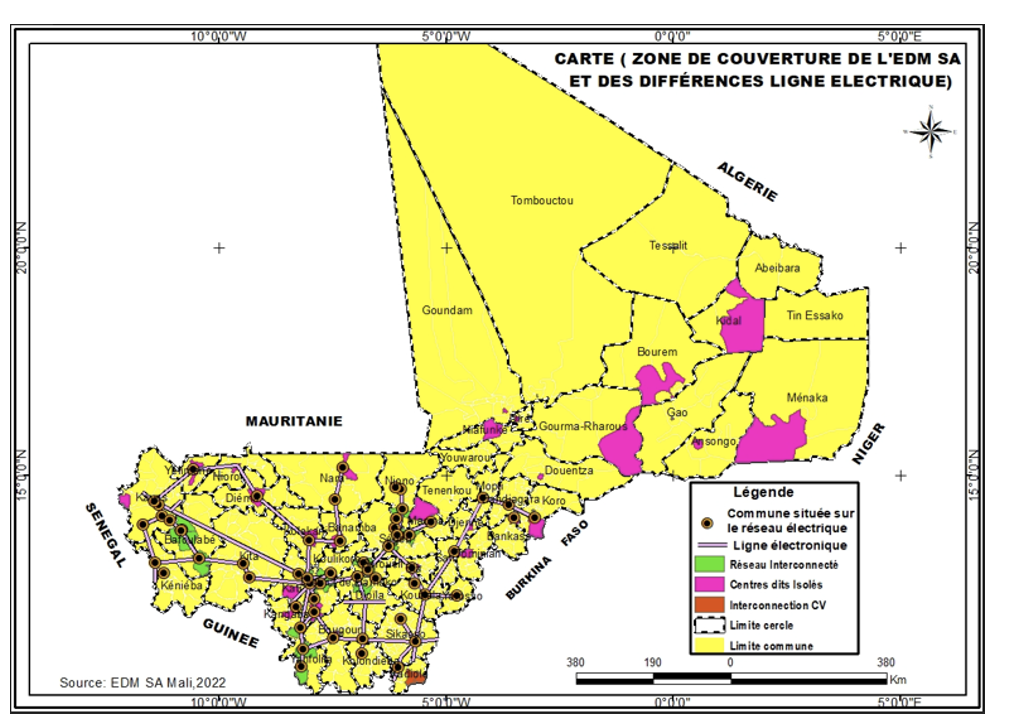
Mali, like many countries in the Sahel-Saharan region, faces major challenges in terms of access to electricity, especially in rural areas. Currently in Mali, a large part of the rural population has no access to a reliable source of energy, which limits the economic and social development of these regions. Conventional energy sources, such as oil-fired power stations, are often unsuitable for remote areas because of the high cost of transport and infrastructure. Mali enjoys abundant sunshine throughout the year, with some of the highest levels of solar irradiation in the world. However, to maximise the efficiency of installations, it is essential to choose the right sites. This study is based on the identification of sites to optimise the production of solar photovoltaic electricity. The methodology used revolves around the identification of optimal sites for the installation of solar photovoltaic panels in rural areas of Mali, by applying Hierarchical Process Analysis (HPA) to prioritise key criteria such as the abundance of solar resources and the absence of reliable electrification services. Potential sites were then assessed using GIS data, incorporating electricity requirements by commune and solar radiation. Using this data and the digital terrain model of the study area, we assessed the potential for electricity production at these sites, which are suitable for solar photovoltaic installations. At the end of this research, it emerged that of the 703 communes in Mali, 68 are served by EDM-SA, 254 are served by AMADER and 66 are located on the national power line. Excluding these communes served by electrification services, 435 communes meeting the criteria were deemed suitable for solar photovoltaic installation.The theoretical solar production potential for the communes studied is 371183.97 MW, with an electricity production capacity of 979925.68 MWh.The installation of these solar power plants will considerably improve access to electricity in these various communes, thereby contributing to the well-being of the inhabitants. The use of photovoltaic solar energy will help to reduce greenhouse gas emissions, thereby improving the environmental sustainability of the area.
Keywords : Analysis, Suitability, Site, Installation, photovoltaic, Rural areas
RESUME
Le Mali, comme beaucoup de pays dans la bande sahélo-saharienne, est confronté à des défis majeurs en matière d’accès à l’électricité, surtout dans les zones rurales. Actuellement au Mali, une grande partie de la population rurale n’a pas d’accès à une source d’énergie fiable, ce qui limite le développement économique et social de ces régions. Les sources d’énergie conventionnelles, comme les centrales électriques au fioul, sont souvent peu adaptées aux zones reculées en raison des coûts élevés de transport et d’infrastructure. Le Mali bénéficie d’un ensoleillement abondant tout au long de l’année, avec des niveaux d’irradiation solaire parmi les plus élevés au monde. Cela fait du solaire photovoltaïque une option prometteuse pour l’électrification rurale.Cependant, pour maximiser l’efficacité des installations, il est essentiel de bien choisir les sites d’implantation. Cette étude est basée sur l’identification de sites appropriés afin d’optimiser la production d’électricité solaire photovoltaique dans ces sites.La méthodologie utilisée s’articule autour de l’identification des sites optimaux pour l’installation de panneaux solaires photovoltaïques en zones rurales du Mali, en appliquant l’Analyse Hiérarchique des Processus (AHP) pour hiérarchiser les critères clés tels que l’abondance des ressources solaires et l’absence de services d’électrification fiable. Les sites potentiels ont ensuite été évalués en utilisant des données SIG des limites administratives des différentes zones rurales, intégrant les besoins en électricité par commune et les données du rayonnement solaire. A partir de ces données et le modèle numérique de terrain de la zone d’étude, nous avons procédé à l’évaluation du potential de production d’électricité dans ces sites adaptés à l’installation solaire phovoltaique. Au terme de cette recherche, il ressort que parmi les 703 communes du Mali, 70 sont desservies par l’EDM-SA, 117 sont desservies par l’AMADER et 81 sont situées sur la ligne électrique Nationale mais n’ayant pas accès à une source d’électricité fiable.En excluant ces communes desservies par les services d’électrification, 435 communes rebondaient aux critères, sont alors jugées appopriées pour l’installation solaire photovoltaique. Le potentiel théorique de production solaire pour ces communes retenues s’élève à 371183,97 MW, avec une capacité de production d’électricité de 979925,68 MWh. L’implantation de ces centrales solaires va considérablement améliorer l’accès à l’électricité dans ces différentes communes, contribuant ainsi au bien-être des habitants. L’utilisation de l’énergie solaire photovoltaïque va contribuer à réduire les émissions de gaz à effet de serre, tout en améliorant ainsi la durabilité environnementale de la zone.
Mots-Clés : Analyse, Adéquation, Site, Installation, photovoltaique, Zones rurales
REFERENCES
05_Bernhard_Thierry_v4_Public.pdf. (s. d.).
Bakamba dit Djénèba et al. (2023). Performance Evaluation of an Installed On-Grid Photovoltaic System at Bamako. American journal of electrical power and energy systems. https://doi.org/10.11648/j.epes.20231201.12
Bhandari,Ba, R., Abdramane. (2021). Rural Electrification Pathways : An Implementation of LEAP and GIS Tools in Mali. Energies, 14(11), 3338. https://doi.org/10.3390/EN14113338
Ebhota, W. S., & Tabakov, P. Y. (2022). Assessment and performance analysis of roof-mounted crystalline stand-alone photovoltaic (SAPV) system at selected sites in South Africa. Bulletin of the National Research Centre, 46(1), 236. https://doi.org/10.1186/s42269-022-00929-3
Feleke, S., Anteneh, D., Pydi, B., Satish, R., El-Shahat, A., & Abdelaziz, A. Y. (2023). Feasibility and Potential Assessment of Solar Resources : A Case Study in North Shewa Zone, Amhara, Ethiopia. Energies, 16(6), 2681. https://doi.org/10.3390/en16062681
- Dekelver et al. (2018). Politique Energétique Nationale_V provi (No. 00 2018 04 03).
Gulaliyev, M. G., Mustafayev, E. R., & Mehdiyeva, G. Y. (2020). Assessment of Solar Energy Potential and Its Ecological-Economic Efficiency : Azerbaijan Case. Sustainability, 12(3), 1116. https://doi.org/10.3390/su12031116
Kaba, M. (2021). RAPPORT sur L’analyse rapide de l’environnement propice et l’évaluation du modele fres.
Poneabo, L. K., & Tchawa, P. (2022). LE POTENTIEL SOLAIRE PHOTOVOLTAÏQUE DU LITTORAL SUD-CAMEROUNAIS. 1(2).
Shepovalova, O., Arbuzov, Y., Evdokimov, V., Ilyushin, P., & Suslov, K. (2023). Assessment of the Gross, Technical and Economic Potential of Region’s Solar Energy for Photovoltaic Energetics.
Susanti Tasri, E., Karimi, K., Muslim, I., & Dwianda, Y. (2022). The influence of economic growth, energy consumption, poverty and population on Indonesia’s environmental quality index. KnE Social Sciences. https://doi.org/10.18502/kss.v7i6.10634
Tunc, A., Tuncay, G., Alacakanat, Z., & Sevimli, F. S. (2019a). GIS BASED SOLAR POWER PLANTS SITE SELECTION USING ANALYTIC HIERARCHY PROCESS (AHP) IN ISTANBUL, TURKEY. The International Archives of the Photogrammetry, Remote Sensing and Spatial Information Sciences, XLII-2/W13, 1353‑1360. https://doi.org/10.5194/isprs-archives-XLII-2-W13-1353-2019
Tunc, A., Tuncay, G., Alacakanat, Z., & Sevimli, F. S. (2019b). GIS BASED SOLAR POWER PLANTS SITE SELECTION USING ANALYTIC HIERARCHY PROCESS (AHP) IN ISTANBUL, TURKEY.
Wilson, T. N. E., & Camille, K. M. (2019). Identification des sites favorables à l’installatiosn des centrales solaires photovoltaïques à l’aide de l’analyse multicritères et des SIG : Cas de l’arrondissement de Bélabo, Cameroun. 26(938‑952).
